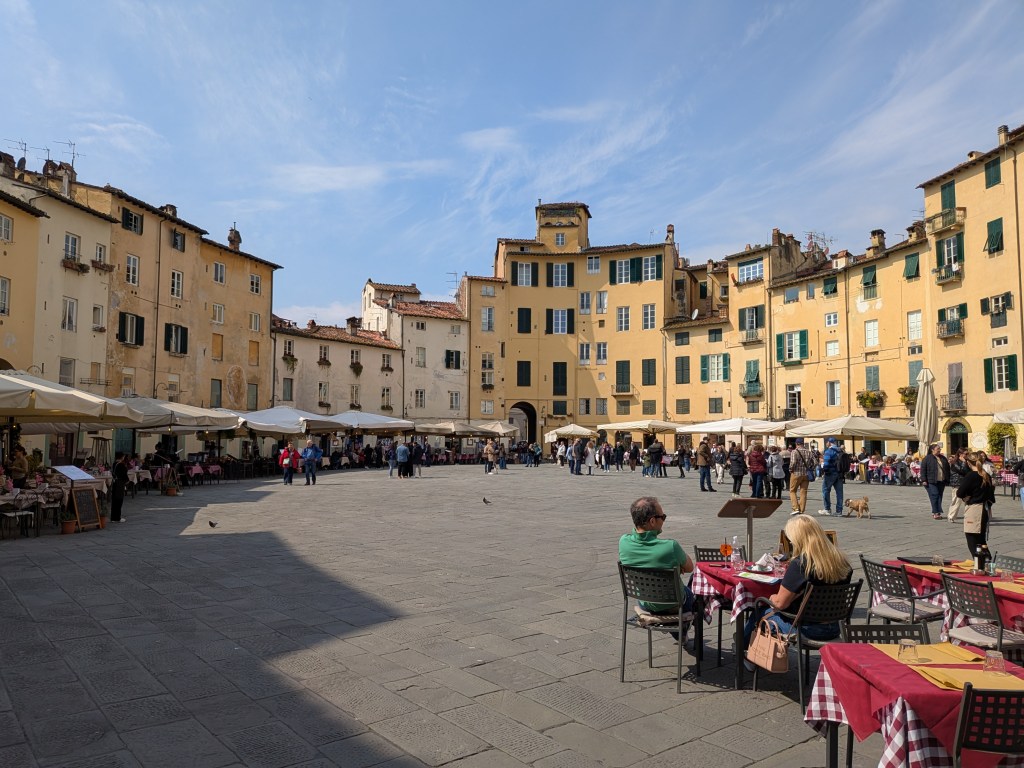
Lucca was at the top of the list of places to visit from the moment we decided to move to Italy. A walled city, beautiful and historic scenery, a slower pace and family nearby. The perfect week away.
Friday, 20 March – The Drive Down
The plan was always to start early, and for once it more or less worked. I was up before the rest of the family to catch the train to Monza and collect our rental — a nearly brand new hybrid Jeep Avenger. It just fit all our luggage with a bit of creative packing in the boot.
We left Merate around 11am and the drive to Lucca is about three and a half hours with no stops — but we made one in Piacenza for lunch. My original plan was to find a proper restaurant and have a wander through the centro storico. Ambitious. I forgot how long it takes to sort lunch with small children. We ended up at the Eataly right next to the car park, which was actually quite good — but by the time we were done it was clear there’d be no time for sightseeing. Back in the car, Ilaria fell asleep almost immediately, and we drove the rest of the way through some genuinely beautiful scenery.
We arrived in Lucca around 5pm. Gabriel met us at the car and walked us to the apartment — a really lovely place inside the walls, belonging to him and Martina. They had gone all out with a welcome: Easter eggs for the kids, a colomba (the traditional Italian Easter cake), and — the touch I’ll remember most — a few cold Ichnusa beers waiting in the fridge. After a long day at the wheel, that was exactly what I needed.
After a quick rest we headed out — the girls and I — to get our bearings. It was around 6pm, still a bit early for dinner, but the city was buzzing with aperitivo hour. Within 50 metres of the apartment there were bars and restaurants everywhere. We found our way to Piazza Napoleone, where to our delight there was a large giostra set up in the square. Issy was immediately enchanted — it brought back strong memories of 2023, the last time we were in Italy, when she fell in love with carousels for the first time.
We eventually found a hotel restaurant on the piazza for dinner. Quiet, relaxed, decent food — definitely a tourist-tax price, but after a long day of driving nobody was complaining.
Saturday, 21 March – Exploring with the Cousins
Breakfast at Stella Polaris, a bar around the corner that would become a regular spot over the week. Then we met Gabriel, Martina, and their two boys — Giacomo and Diego — in the piazza. The kids went straight for the giostra, naturally. A couple of rides sorted, we set off to explore the city together.
Lucca rewards wandering. We made our way to Piazza dell’Anfiteatro for lunch — the remarkable oval piazza built directly over the footprint of a Roman amphitheatre — then got gelato and continued through the streets. Ilaria fell asleep in the pram, which is always a good sign.
In the afternoon we found a playground on the wall — right beside some ancient ruins, as these things tend to be in Italy — then rented a rickshaw and cycled the full circuit of the walls. The walls of Lucca are extraordinary: wide enough to walk and cycle along the entire 4km perimeter, lined with trees, with views over the terracotta rooftops on one side and the Apennines on the other. The kids absolutely loved it.
We stopped for coffee and more playing in Piazza Napoleone while Rose did the grocery shopping. Issy had been taking photos with her camera — she’s taken to photography this trip — but she tripped and hurt her head and knee. I took her back to the apartment with some ice. By the time Rose came home, Issy was on the mend. We said goodbye to the cousins and made plans to meet the next day at the beach.
Sunday, 22 March – A Day at Lido di Camaiore
Gabriel and Martina have a holiday apartment in Lido di Camaiore, a seaside town about 20 minutes from Lucca on the Versilian coast. We drove over after breakfast for the day.
As part of my marathon training, I went for a 30km run along the beach while everyone else went to lunch. It was a great stretch to run — fairly flat, with a dedicated track along the road and the Tyrrhenian Sea to one side. By the time I finished and showered back at the apartment, the family were already at the beach. The bigger kids were still playing in the sand; the little ones were asleep in the pram.
Gabriel walked me over to a nearby pizza place to refuel after the run, and then the rest of the family joined us. It had started as a warm, sunny day but the clouds rolled in during the afternoon and it turned cold quickly — that particular coastal Tuscan weather. We packed up, said our goodbyes, and drove back to Lucca.
Back in the city, we squeezed in a giostra ride (naturally), browsed some shops — Rose found some clothes for the girls — and ended the day at a lovely trattoria for dinner. It was quiet and unhurried. They brought a plate of local delicacies and a glass of prosecco on the house, which felt like a very generous and very Italian touch.
Tuesday, 24 March – Working from Lucca
A working day for me, spent at the apartment. Rose took the girls out for a horse ride along the walls — one of those only-in-Lucca experiences. I spotted them on my afternoon run and managed to say a quick hello as they went past.
For lunch I ducked into a local bar: a salami panino and a caffè. I ended up chatting with the barista and made a bit of a friend. That evening Rose went out for dinner with Martina, so I had a quiet one at home with the girls.
Wednesday, 25 March – Dinner with Gabriel
Another day working from the apartment. Back to Stella Polaris for lunch, where I noticed a Perth sticker on a laptop behind the bar. The barista told me it was the owner’s — an Australian. Of course.
That evening Gabriel and I had dinner together at Ciacco on Piazza Napoleone — a really good spot, great food, easy conversation. Afterwards we went for a beer at De Cervesia, a craft beer bar that turned out to be a gem: excellent selection, cool atmosphere, the kind of place you’d go back to every visit.
Thursday, 26 March – Dinner at Carla’s
Work again during the day, then at five o’clock we drove out to Borgo a Mozzano, a small town about 20 minutes north of Lucca where Gabriel lives. They share a block with Carla — Gabriel’s mum — and Michael, Gabriel’s older brother. We had aperitivo at Gabriel’s while the kids ran around, then crossed over to Carla’s for dinner, where Michael and his girlfriend Martina joined us.
Going back there brought back a lot of memories — I first visited in 1999. Some things feel timeless about family homes like that. A warm, loud, generous dinner in the way that only Italian family gatherings can be.
Friday, 27 March – Lunch with Ermanna and Pietro
I got up early to start work so I could finish by lunchtime — we had plans to visit my other cousins, Ermanna and Pietro, who live just outside the walls. We met them at their apartment and walked together to Molin della Volpe, a restaurant they’d taken us to on a previous visit. No complaints: the food was delicious and the setting genuinely lovely.
After lunch we went back to theirs for a while before heading back to the apartment to sort the girls out for dinner. And yes — one more giostra ride before bed. At this point it had well and truly become a nightly ritual.
Saturday, 28 March – Heading Home
After breakfast we took one final walk through the city and had a last giostra ride. Issy was sad to leave — which felt like a very good sign. She’d been a little uncertain at first (still adjusting after leaving Merate), but the giostra on the very first evening had won her over, and by the end she didn’t want to go. We’ll take that.
The drive home included a stop at an Autogrill for lunch and to fill up the car. There’s something about the Autogrill that doesn’t really exist anywhere else — a motorway service station elevated into something genuinely enjoyable. Hot food, decent coffee, a pastry, a browse. It’s one of the small Italian pleasures that simply has no equivalent in Australia.
We made it back safely — tired, but very glad we’d gone. Lucca delivered everything we’d hoped for: beautiful streets, great food, the girls having a wonderful time, and the rare gift of a week spent with family. We’ve already vowed to return to Tuscany before the year is out.
A Brief History of Lucca
Walking the streets of Lucca, it’s hard not to feel the weight of history underfoot. The city has been continuously inhabited for over two millennia, and that depth shows in everything from the street layout to the piazzas to the very walls you cycle along.
Lucca was founded by the Etruscans and later settled by the Ligurians before becoming a Roman colony in 180 BC. The Romans left a permanent mark: the rectangular grid of the old town follows the original Roman plan almost exactly, and Piazza San Michele — one of the city’s most elegant squares — stands on the site of the ancient forum. In 56 BC, Lucca played host to one of the most consequential political meetings of the ancient world, when Julius Caesar, Pompey, and Crassus gathered here to reaffirm the First Triumvirate.
Through the early Middle Ages, Lucca was a city of considerable importance. The Lombards made it the capital of the Duchy of Tuscia from 576 to 797, governing much of what is now Tuscany from within these walls. By the 10th and 11th centuries it was the seat of the feudal margravate of Tuscany, and after the death of the celebrated Countess Matilda of Tuscany, it began to constitute itself as an independent commune — receiving a formal charter in 1160. In the early 14th century, under the remarkable condottiero Castruccio Castracani, Lucca became one of the most powerful city-states in central Italy, for a time rivalling Florence itself.
The Renaissance brought prosperity on the back of silk. Lucca became the foremost centre of silk production in all of Italy, exporting elaborate fabrics across Europe and as far as Asia. Its wealthy merchant families commissioned extraordinary art and architecture in return. When Paolo Guinigi’s young wife Ilaria del Carretto died in childbirth in 1405, he commissioned a marble tomb from sculptor Jacopo della Quercia that is considered one of the masterpieces of early Renaissance art — it can still be seen today in the Cathedral of San Martino.
The walls themselves are a Renaissance achievement. Construction began in 1504 and continued for nearly 150 years, producing one of the best-preserved sets of Renaissance fortifications in Europe: four kilometres in circumference, wide enough at the top for tree-lined promenades, cyclists, and horse riders. They were built by the Republic of Lucca to defend against Florentine expansionism, though they were never put to military use. That republic — one of the longest-surviving independent city-states in Italy, second only to Venice — endured until Napoleon arrived in 1805 and handed the city to his sister Elisa Bonaparte Baciocchi as her personal principality.
Today Lucca is famous for its music (it was the birthplace of Giacomo Puccini), its food, its festivals, and above all for those walls — now a public park, a space for the evening passeggiata, for school groups, for horse rides and rickshaw rentals, and for children falling in love with a city that has been here, in one form or another, for more than two thousand years.
 Patrick's blog
Leave a comment